
Avoiding Capital Allocation Mistakes in Startup Investments
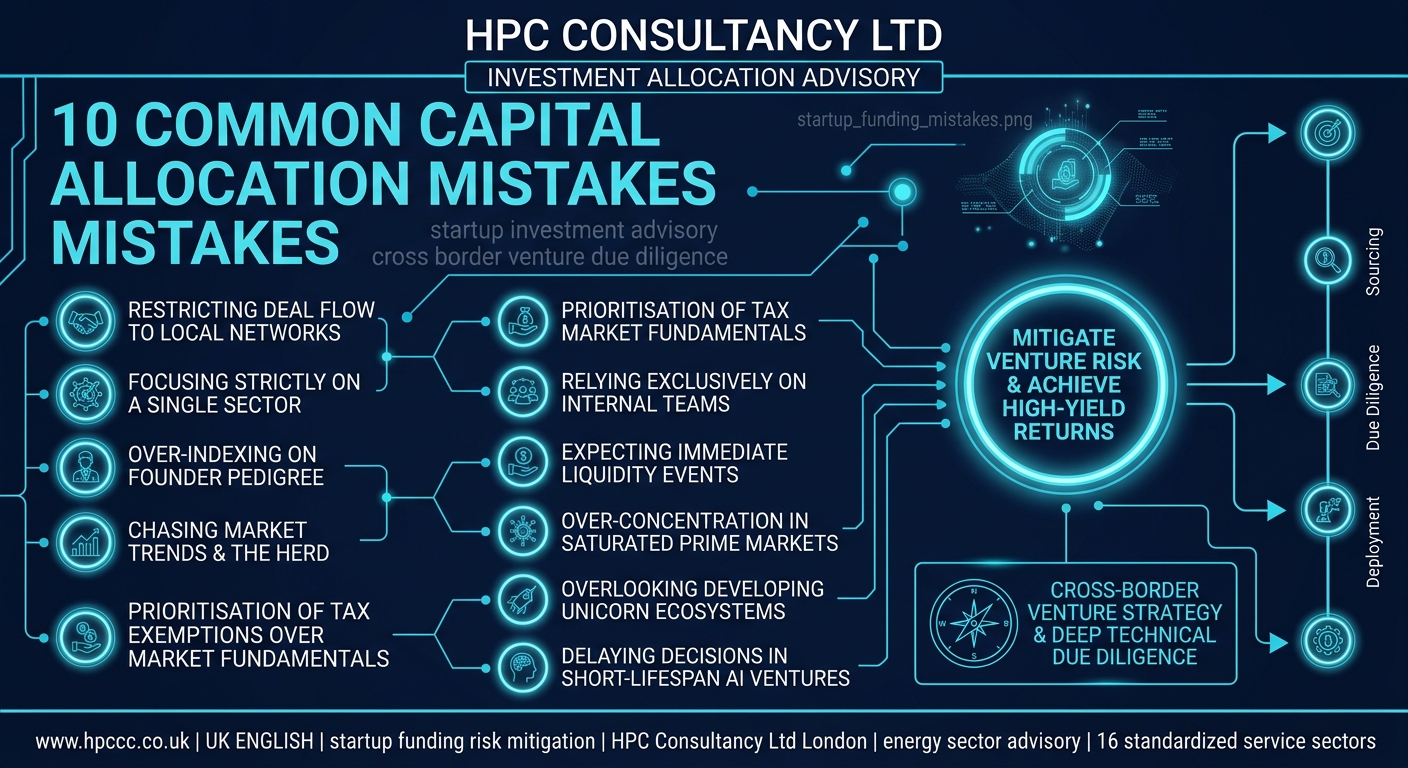
Investing in early stage startups carries significant risk, and Romania investors often waste substantial time and capital by committing preventable mistakes during deal selection, due diligence, and portfolio management. In an environment defined by rapid technological shifts and Romania economic realignments, failing to apply proper analytical rigor leads directly to misallocated capital, wasted effort, and portfolio write offs.
At HPC Consultancy Ltd, evaluating cross border opportunities and venture frameworks reveals that 90 out of 100 underperforming startup investments stem not from an absence of market opportunity, but from unconsulted, flawed investment decisions. Investors who rely on outdated biases, insular networks, and superficial metrics regularly miss high yield opportunities while backing fragile ventures.
Ten Common Venture Capital Allocation Mistakes
Systemic capital loss occurs when investors prioritize emotional bias, herd sentiment, or superficial metrics over technical feasibility, market scalability, and structured due diligence.
1. Restricting Deal Flow to Local Networks
Limiting deal sourcing to immediate geographical or personal networks severely restricts access to quality opportunities. Investors without a cross border perspective miss high growth ventures emerging in international innovation hubs, leaving their capital exposed to localized market saturation and regional economic friction.
2. Focusing Strictly on a Single Sector
Failing to diversify across complementary industries prevents investors from capturing cross sector technological advancements. Allocating capital exclusively within one familiar vertical creates domain blindness, making it difficult to spot emerging, high margin opportunities across adjacent industries.
3. Over-Indexing on Founder Profiles
Focusing too heavily on a founder's pedigree, academic credentials, or charisma while ignoring flawed unit economics, weak product market fit, or unsustainable burn rates is a major cause of early stage failure. Strong leadership alone cannot salvage an unviable core business model.
4. Chasing Market Trends and Following the Herd
Participating in competitive funding rounds merely to follow prominent venture firms or market hype leads to inflated valuations and poor deal terms. Following herd sentiment without conducting independent technical and financial evaluations dilutes overall portfolio yield.
5. Prioritising Tax Exemptions over Market Demand
Selecting target jurisdictions based primarily on tax breaks or regulatory subsidies rather than true addressable market size, infrastructure resilience, and customer demand creates artificial business models. Real market demand must always take priority over tax optimization.
6. Relying Exclusively on Internal Teams
Relying entirely on internal teams to assess complex, specialized technologies introduces confirmation bias and critical knowledge gaps. Independent, specialized external advisory is necessary to conduct objective technical audits and verify market feasibility.
7. Expecting Immediate Liquidity Events
Expecting quick exits instead of supporting foundational, long term technology development leads to premature sales or misaligned growth strategies. Building sustainable enterprise value demands patient capital deployment and long vision.
8. Over-Concentrating Capital in Saturated Prime Markets
Focusing capital exclusively on hyper competitive, high cost financial hubs increases entry valuations and operational overheads. Investors frequently overlook emerging, high yield innovation hubs that offer lower capital burn and superior growth trajectories.
9. Overlooking Developing Unicorn Ecosystems
Ignoring nascent technological ecosystems that possess strong developer density, supportive policy frameworks, and low operational costs prevents early positioning in future high valuation enterprises. Early entry into developing markets yields disproportionate equity upside.
10. Delaying Decisions in Short-Lifespan AI Ventures
Failing to act quickly in rapidly evolving domains like artificial intelligence forfeits first mover advantage. Early stage AI applications often operate within narrow strategic windows before foundational model upgrades occur, requiring capital deployment within tight operational timelines.
Strategic Investment Advisory with HPC Consultancy Ltd
Navigating cross border deal structuring, multi sector analysis, and deep technical due diligence requires objective, experienced advisory. HPC Consultancy Ltd provides global investors, family offices, and venture firms with the strategic guidance required to mitigate allocation risks and capture resilient, cross border returns.
-
Entity: HPC Consultancy Ltd
-
Core Focus: Startup Funding Advisory, Cross-Border Venture Structuring, Technical Due Diligence, Multi-Sector Investment Strategy
-
Main Office: London, United Kingdom
-
Corporate Domain: www.hpccc.co.uk